

How To Collaborate With YouTube Influencers
Collaborating with YouTube influencers in 2026 is one of the most effective ways to grow your brand or channel. By partnering with creators whose audiences align with your goals, you can expand your reach, increase engagement, and build trust. Here’s what you need to know:
- Why Collaborate? Collaborative videos see 2.3x higher engagement rates and leverage YouTube’s algorithm to boost visibility. Sixty-one percent of viewers trust influencer recommendations more than traditional ads.
- Finding Influencers: Look for creators with a healthy view-to-subscriber ratio (5–15%) and engagement rates that match your niche (e.g., 3–8%). Tools like Outlier can help identify suitable partners and analyze trends.
- Outreach Tips: Personalize your pitch by referencing specific content and offering clear value. Avoid generic emails, as only 6–12% get responses. Timing and follow-ups are key.
- Contracts Matter: Always use written agreements to clarify deliverables, payment terms, exclusivity, and usage rights. Include clear deadlines and FTC compliance requirements.
- Compensation Models: Options include flat fees, performance-based payments, affiliate commissions, or product gifting. Flat fees are predictable, while hybrid models balance guaranteed pay with incentives.
- Execution and Review: Provide clear briefs, ensure proper disclosures, and track performance with tools like UTM links and promo codes. Evaluate metrics like view velocity and conversions over 60–90 days.
Partnering with the right influencers can deliver strong results when done thoughtfully. Focus on building long-term relationships to maximize impact.
How To Collaborate With Other Influencers/Creators
sbb-itb-08cadfc
Finding the Right YouTube Influencers for Your Brand
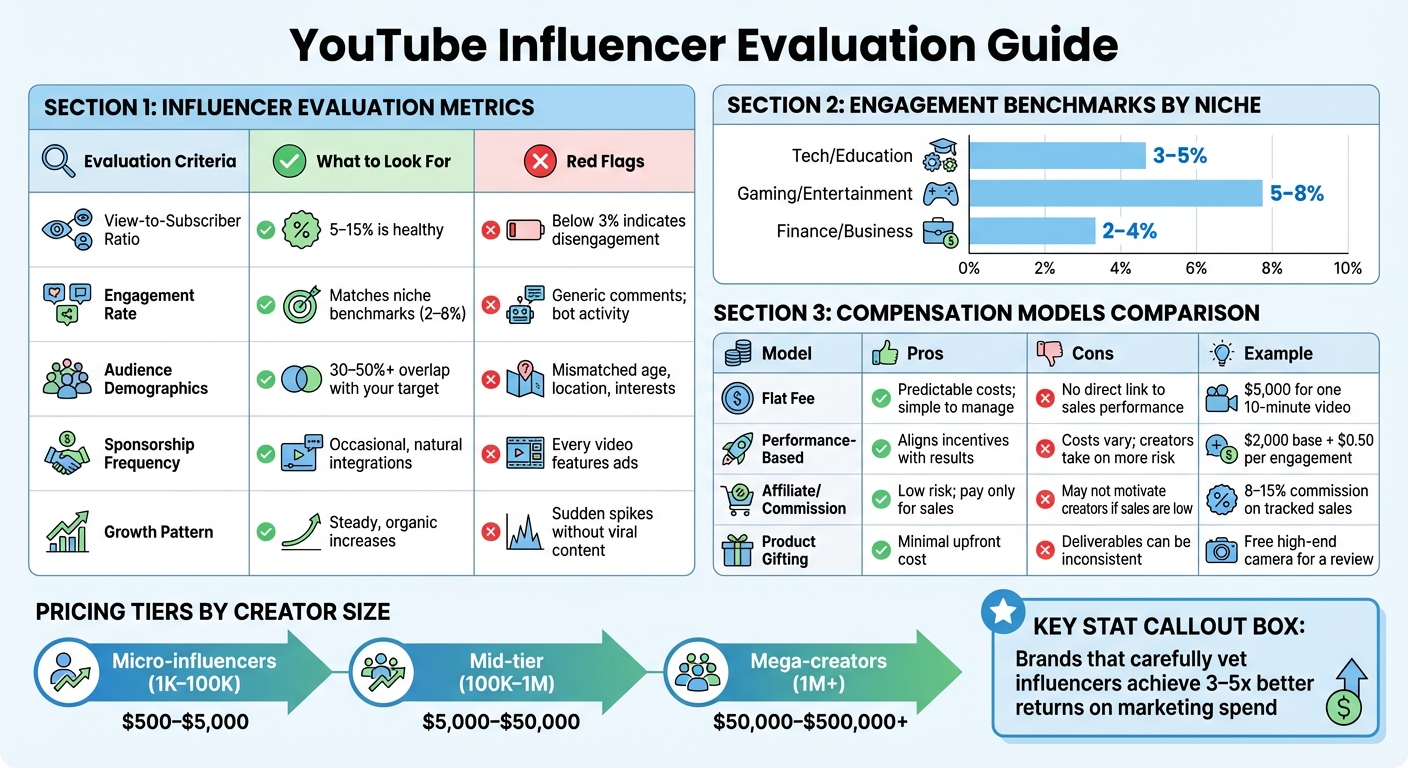
YouTube Influencer Evaluation Criteria and Compensation Models Guide
To build successful partnerships, you need to work with creators whose audiences genuinely connect with your brand. A good starting point is checking the median views from their last 20 uploads. A healthy view-to-subscriber ratio typically falls between 5–15%. If it’s below 3%, it might indicate a disengaged audience, while anything above 20% suggests strong viewer loyalty.
Start by analyzing your competitors’ influencer collaborations. Look at the creators they’ve partnered with and pay attention to audience reactions in the comments. You can also search for niche-specific keywords on YouTube to find creators whose content aligns with your industry. For more in-depth analysis, tools like Outlier can help identify trending content and highlight what resonates with your target audience by examining competitor channels and view trends.
Research Methods for Finding Influencers
When evaluating potential partners, review their last 5–10 videos to assess production quality, consistency, and how naturally they incorporate sponsored content. Be cautious of creators who have recently promoted competing products, as this could dilute your message.
Discovery platforms can streamline your search by letting you filter creators based on metrics like location, age demographics, and niche keywords. Many of these tools also offer "lookalike" features, where you can input a successful channel to generate a list of similar creators with comparable audiences - saving you countless hours of manual research.
Request analytics from potential partners, such as a YouTube Studio "Audience" snapshot and "Returning vs. New Viewers" data for the past 1–3 months. These insights will help you gauge audience loyalty and determine if the creator’s followers align with your goals.
"Always request video retention, following growth over time, and returning vs. new viewers (1 & 3 months). These should give you a good insight into who will watch your content and whether that aligns with your objectives."
– Marit Tiesema, Sr KOL & Ambassador Specialist, Loop Earplugs
Evaluating Influencers for Collaboration
When it comes to influencer marketing, engagement quality outweighs sheer numbers. Dive into their comment sections to identify genuine interactions rather than generic praise or suspicious bot activity. Creators who actively respond to their followers tend to build stronger trust within their communities. Engagement benchmarks vary by niche - Tech/Education channels often see 3–5%, Gaming/Entertainment 5–8%, and Finance/Business around 2–4%.
It’s also important to examine the creator’s growth history. Sudden spikes in subscriber counts without a viral video could indicate purchased followers. Ideally, at least 30–50% of a creator’s audience should overlap with your target demographic. Remember, 50,000 engaged viewers can be far more effective than a million passive subscribers.
Take a look at their sponsorship history. Creators who frequently feature sponsored content in every video may lead to audience fatigue. Focus on those who integrate products naturally - an overly forced sales pitch can come across as insincere and alienate viewers. Lastly, ensure their content style (whether it’s tutorials, vlogs, or reviews) matches how your audience prefers to consume information.
Here’s a quick reference table to assess influencer metrics:
Evaluation Criteria
What to Look For
Red Flags
View-to-Subscriber Ratio
5–15% is healthy
Below 3% indicates disengagement
Engagement Rate
Matches niche benchmarks (2–8%)
Generic comments; bot activity
Audience Demographics
30–50%+ overlap with your target
Mismatched age, location, interests
Sponsorship Frequency
Occasional, natural integrations
Every video features ads
Growth Pattern
Steady, organic increases
Sudden spikes without viral content
Start small by testing creators with gifting campaigns or affiliate deals. This approach allows you to measure performance before committing to larger contracts. Brands that carefully vet influencers often achieve 3–5x better returns on their marketing spend.
Once you’ve narrowed down your list of influencers, the next step is learning how to approach and pitch them effectively for collaboration.
How to Approach and Pitch YouTube Influencers
Once you've pinpointed the right creators, how you reach out can make or break your chances of getting a response. In 2026, influencers receive anywhere from 50 to 200 pitches every month, but only a small fraction - about 6–12% - of generic, mass emails get replies. The key to standing out? A pitch that feels both personal and professional.
Writing Personalized Pitches
Before you even start writing, spend about 15 minutes researching the creator. Watch their last 10–20 videos to get a feel for their style, recurring themes, and how they connect with their audience. Skip generic compliments like "I love your channel" and instead mention specific details, like "Your breakdown of [topic] in last week's video was the clearest explanation I've seen". This shows you’re genuinely familiar with their work.
Aim to dedicate most of your time - 70% - to research and only 30% to actually drafting the pitch. Keep it short and to the point, ideally 100–150 words. For your subject line, stick to 6–10 words, as this length tends to achieve open rates of 45–50%. A subject line like “[Name], Collab based on your [specific recent post]” can help your email stand out in their inbox.
When structuring your pitch, include these five elements:
- Hook: Reference a specific piece of their content.
- Value Proposition: Explain what’s in it for them.
- Collaboration Details: Clearly outline deliverables and timelines.
- Social Proof: Mention past successes or collaborations.
- Call-to-Action: End with a clear next step, like a link to schedule a quick call.
Be upfront about compensation, whether it’s a flat fee, revenue share, or affiliate arrangement. Creators value transparency and creative freedom, so avoid overly rigid scripts. Remember, influencers see these partnerships as professional work, not casual favors.
Personalized pitches can boost your response rate by 35% compared to generic templates. Be specific with deliverables - such as "one 12–15 minute video, two YouTube Shorts, and one Community post" - and reach out 4–8 weeks before your planned launch to give them enough time for production.
Best Practices for Outreach
Email remains the go-to communication method for 72% of brands collaborating with creators, especially those with over 50,000 subscribers. For smaller nano-influencers, Instagram DMs can work well for initial contact, but always follow up with a formal proposal via email. Timing matters too - send your pitch between Tuesday and Thursday, ideally between 9:00 AM and 3:00 PM in their local timezone, for the best response rates.
If you don’t hear back after 5–7 days, send a polite follow-up. Add something new to the conversation, like updated campaign details or audience insights. Use a three-touch sequence: your initial pitch on Day 1, a follow-up on Day 7, and a final message on Day 14. Interestingly, 65% of successful collaborations happen only after a follow-up. If you still don’t get a response after three attempts, move on gracefully without burning bridges.
Adjust your tone based on the influencer’s tier. Nano-influencers (1,000–10,000 subscribers) generally prefer a more casual, collaborative approach, while macro-creators (100,000–1 million subscribers) often expect a more polished, agency-style pitch. Always respect their time and provide an “easy out” if they’re not interested.
If your email goes unanswered, consider sending a short, friendly DM on another platform after a few days. Keep it casual and low-pressure. Also, keep in mind that YouTube creators often need 2–4 weeks to produce content, so a delayed response might just mean they’re busy.
Negotiating Contracts and Compensation
Once you've piqued interest with personalized pitches, the next step is locking in the details with a written contract. Why? Because written agreements prevent misunderstandings. In fact, 87% of payment disputes and 92% of content delivery issues are avoided when there's a clear contract in place. It's worth noting that 73% of creators believe sponsorship disagreements could have been sidestepped with a strong agreement from the start. With influencer disputes rising 34% between 2025 and 2026, documenting everything is more important than ever.
Key Elements of Collaboration Agreements
Every partnership agreement should address the scope of work and deliverables. This means specifying the number of videos, their length (e.g., 8–12 minutes), product placement details (like intro or mid-roll), and timing (such as featuring the product within the first two minutes). Ambiguity here leads to confusion, so be precise.
Define content rights and ownership clearly. Most creators retain ownership of their work while granting brands a limited license for usage, typically lasting 12–24 months. If you want to use the content in your ads (referred to as "media buy rights"), expect to pay an additional 25% to 40% above the base fee. For perpetual rights, which allow you to use the content indefinitely, the cost is significantly higher.
Exclusivity and non-compete clauses are another crucial aspect. These clauses outline how long the influencer cannot promote your competitors, often ranging from 30 to 90 days. To avoid overly broad restrictions, limit exclusivity to 3–5 specific competitors.
Don't overlook FTC disclosure requirements. Your contract must ensure the creator uses proper tags like #ad or #sponsored, YouTube's "Paid Partnership" label, and mentions the sponsorship in the video, title, and description. As Elen, Chief Content Marketer at IQFluence, explains:
"If your influencer posts without the right hashtags or disclosure phrases (#ad, #sponsored, etc.), guess who's in trouble? Yep - you and them."
Modern agreements also include AI and deepfake clauses to safeguard against unauthorized use of the creator's likeness or voice through AI tools. Additionally, include termination and liability terms, such as "morality clauses" that allow either party to exit the deal in case of a public scandal, along with indemnification for copyright or product-related issues.
Set clear deadlines for every stage of the project. Include a production schedule with a kickoff date, draft submission deadlines, a review window (typically 48–72 hours), and the final posting date. Limit revisions to two or three rounds, and specify extra charges - ranging from $250 to $1,000 per additional round - to avoid scope creep.
For larger deals, consider milestone payments. Splitting payments (e.g., 50% upfront and 50% upon completion) protects both parties and ensures commitment throughout the process.
Comparing Compensation Models
Choosing the right payment model depends on your goals, budget, and the creator's preferences. Here's a breakdown of common options:
Compensation Model
Pros
Cons
Example
Flat Fee
Predictable costs; simple to manage.
No direct link to sales performance.
$5,000 for one 10-minute video.
Performance-Based
Aligns incentives with results.
Costs vary; creators take on more risk.
$2,000 base + $0.50 per engagement.
Affiliate/Commission
Low risk; pay only for sales.
May not motivate creators if sales are low.
8–15% commission on tracked sales.
Product Gifting
Minimal upfront cost.
Deliverables can be inconsistent.
Free high-end camera for a review.
Tiered/Milestone
Spreads risk over time.
More effort to track.
25% at signing, 25% at draft, 50% at posting.
Flat fees are ideal for predictable budgets, especially when the goal is brand awareness rather than direct sales. Rates vary based on creator size: micro-influencers (1,000–100,000 subscribers) typically charge $500–$5,000 per video, mid-tier creators (100,000–1 million subscribers) range from $5,000–$50,000, and mega-creators (1 million+ subscribers) can command $50,000–$500,000 or more.
Creator niche also plays a big role in pricing. For example, YouTube CPM benchmarks show Finance and Fintech content earning $15–$25 per 1,000 views, Gaming at $8–$15, and Beauty/Fashion at $10–$20. High-value niches often charge significantly more due to their audience's purchasing power.
Performance-based and affiliate models shift more risk to creators but align pay with results, making them great for campaigns focused on measurable conversions. Hybrid models, like a $1,500 base fee plus $500 per 100,000 views, are gaining traction because they balance guaranteed pay with performance incentives.
Product gifting is the most cost-effective option upfront but tends to deliver weaker results. It works best for nano-influencers trying to grow their portfolios, while established creators expect monetary compensation.
Filip Allard from IQFluence puts it best:
"The brands that take the time to put together a thoughtful influencer collaboration agreement template run way smoother campaigns and build way better long-term influencer relationships."
Executing and Reviewing Your Collaboration
Once the contract is signed, the next step is ensuring everything runs smoothly from the start. Clear communication and a well-crafted influencer brief are key to turning your brand’s strategy into actionable content. This brief sets the tone for the collaboration, aligning expectations and guiding the creative process. With everything in place, it’s time to focus on execution and reviewing the results.
Setting Clear Expectations and Providing Briefs
Your influencer brief should strike a balance between being detailed and leaving room for creativity. Include the essentials: your brand’s background, target audience, deliverables (like format and length), messaging points, visual guidelines, and deadlines. Break down your goals into smaller objectives, such as “capture attention in the first 10 seconds” or “showcase the product’s benefits with a before-and-after demo”.
Structure your messaging into three distinct parts:
- Hook: Grab attention right away.
- Proof: Build interest with demos, testimonials, or other compelling elements.
- CTA (Call-to-Action): Guide the audience toward the desired action.
It’s also helpful to add a “Do’s and Don’ts” section. This could include your brand’s dealbreakers, mandatory disclosures (like #ad or #sponsored), and other non-negotiable elements. However, avoid being overly prescriptive. As Jordan Bettinson from Later points out:
"If you over-plan and micromanage, you run a huge risk: 'You lose authenticity.' ... You remove the raw feelings or the experience when you get too scripted."
To support the content creation process, provide resources like a shared Google Doc with shot lists, equipment requirements, brand assets (logos, high-quality product images), and any other helpful materials. Make sure deadlines for drafts are clear - aim for 5–7 days before the posting date - and outline how many rounds of revisions are allowed. Before sending the brief, ask yourself: “Is this clear enough for the creator to execute without needing to ask follow-up questions?”
Reviewing Content and Measuring Performance
When the draft is ready, compare it against your brief and guidelines. Look for consistency in tone, visual style, and messaging. Check for typos, inaccuracies, or technical errors that could hurt your brand’s credibility. Make sure FTC disclosures are properly included - hashtags like #ad or #sponsored, mentions in the title, and YouTube’s “Paid Partnership” label are all essential.
When providing feedback, be specific. For example, say, “Add a personal story to better connect with viewers,” instead of vague comments like “this is boring”. Allow creators at least 48 hours to make edits. Before giving final approval, double-check that all links work, promo codes are accurate, and the CTA is clear.
Once the content is live, shift your focus to tracking performance. Pay close attention to view velocity - how quickly the video gains views in the first 48 hours. Dive into the comments section to gauge genuine engagement. Thoughtful questions are a good sign, while generic praise might hint at bot activity. Use tools like Google Analytics 4 (GA4) with UTM links and custom promo codes to track conversions. Focus on meaningful metrics like click-through rates (CTR), promo code usage, and sales instead of vanity metrics like total views.
For deeper insights, tools like Outlier can analyze trends such as view velocity and engagement patterns, helping you pinpoint what’s working. Keep in mind that YouTube videos often generate 30–40% of their lifetime views after the first month. So, measure ROI over 60–90 days instead of just the launch week. Use these learnings to improve your future influencer campaigns.
Conclusion
Working with YouTube influencers isn’t just about reaching a massive audience - it’s about finding creators whose followers genuinely align with your brand. Focus on identifying influencers with audiences that match 50% to 500% of your subscriber count. For example, if you have 10,000 subscribers, aim for creators with 5,000 to 50,000 subscribers. Additionally, prioritize creators with strong engagement rates, typically around 3–8%. When reaching out, make your pitch personal by referencing their recent content and clearly outlining how the collaboration benefits them. Personalized outreach can significantly boost response rates, jumping from 0–5% for generic emails to 20–30% for tailored ones. Once you’ve found the right partner, formalize the collaboration with a clear agreement.
Your contract should outline all deliverables, payment terms (like Net 30), usage rights, exclusivity clauses, and a brief that allows creative flexibility. A proven approach is the "two-video strategy", where both you and the influencer post videos on your respective channels to maximize cross-promotion.
After launching the campaign, monitor key metrics like view velocity, engagement rates, and conversions. Tools like UTM links or promo codes can help track performance. Keep in mind that YouTube videos often generate 30–40% of their lifetime views after the first month, so evaluate ROI over 60–90 days rather than focusing only on the initial week. Use these insights to refine your strategy and adapt to evolving industry trends.
The creator economy is projected to hit $250 billion by 2025, with influencer marketing delivering ROI that’s 11 times higher than traditional digital marketing. To stay ahead, leverage data-driven tools like Outlier to identify trending topics and content strategies that resonate with your audience. These insights can help you craft campaigns that perform exceptionally well and scale effectively.
Finally, think beyond one-off collaborations. Treat influencers as long-term partners by sharing performance data, celebrating successes together, and building on what works. This approach not only strengthens your relationship with the creator but also benefits your brand and both of your audiences, creating a win-win dynamic for everyone involved.
FAQs
What’s the fastest way to verify an influencer’s audience is real?
Analyzing an influencer’s audience starts with checking their engagement metrics. A high follower count paired with low engagement is a major red flag. This could indicate fake followers or the use of engagement pods - groups that artificially inflate likes and comments.
To save time and ensure accuracy, consider using analytics tools designed to detect these patterns. These tools can quickly identify suspicious activity, making the process far more efficient than manually reviewing followers one by one.
How much creative control should I keep in a YouTube collab?
The amount of creative control often hinges on the partnership and shared understanding between both parties. It's important to establish clear guidelines around messaging, branding, and themes upfront. At the same time, giving creators the freedom to infuse their unique style is essential. Striking this balance helps maintain authenticity, strengthens trust, and ensures the content aligns with your objectives while connecting with the audience effectively.
Which metrics matter most for ROI over 60–90 days?
Key metrics to track ROI over a 60–90 day period include audience engagement rate, watch time quality, and demographic alignment. These indicators provide insight into how well the content resonates with viewers and whether it effectively connects with your target audience, ensuring sponsorship efforts deliver meaningful results.


