

How Data Helps Prioritize YouTube Topics
Struggling to grow your YouTube channel? Here's the key: use data to guide your content decisions. Most creators focus on production quality but miss the mark on understanding what their audience truly wants. Did you know 95% of YouTube videos never surpass 1,000 views? The solution lies in leveraging analytics to identify high-demand topics before creating content.
Creators who prioritize data over guesswork often see 40–60% higher view counts. Tools like YouTube Analytics and Outlier make it easier to understand your audience, track performance, and analyze competitors. By focusing on metrics like Click-Through Rate (CTR) and Average View Duration (AVD), you can create videos that align with viewer preferences and trends.
Key Takeaways:
- Study internal metrics like CTR, AVD, and audience retention to improve your content.
- Use tools like Outlier to analyze competitor videos and spot trending topics.
- Identify content gaps to target high-demand, low-competition niches.
- Prioritize topics based on demand, competition, and performance data.
- Organize content into categories (e.g., evergreen, trending) for consistent growth.
This data-driven approach helps creators move beyond guesswork, making it easier to grow their channel and connect with their audience.
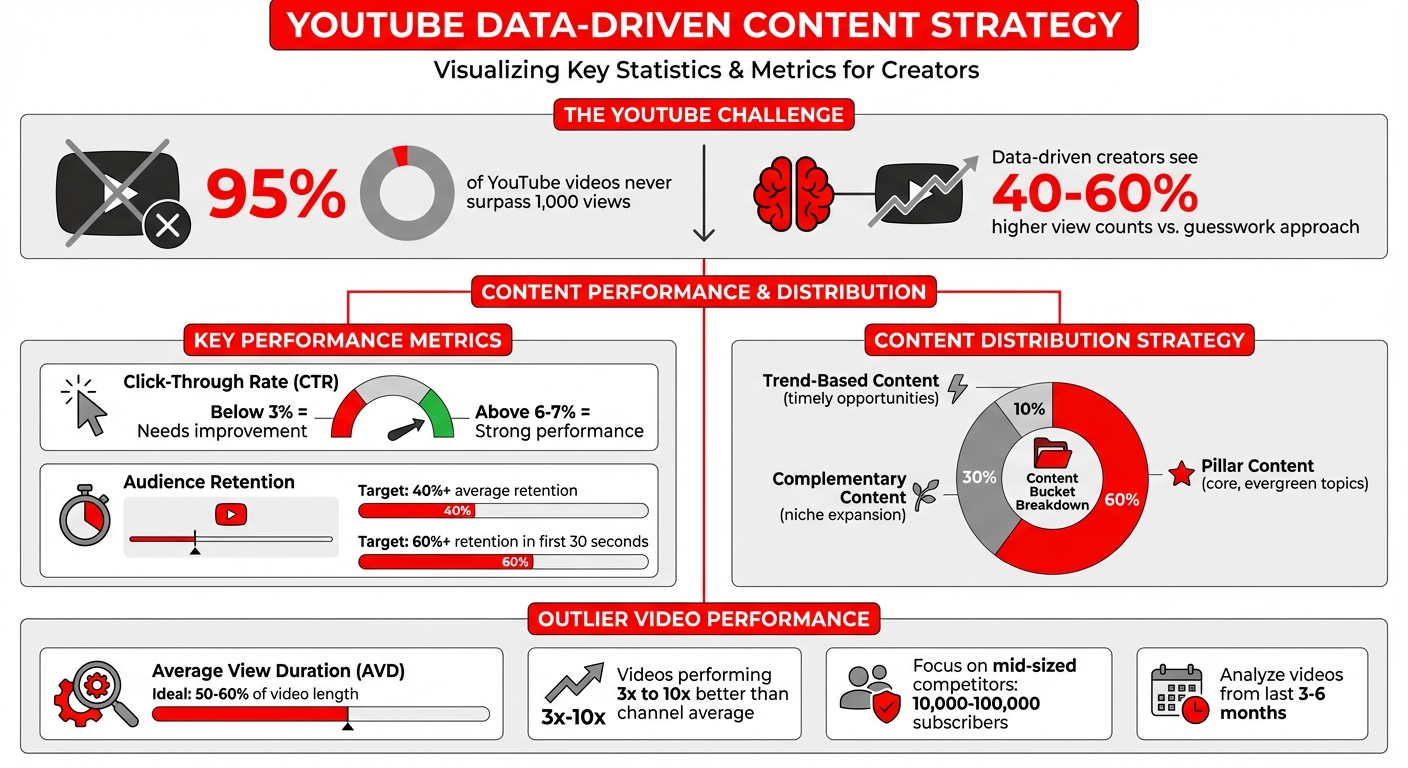
YouTube Content Strategy: Key Statistics and Performance Metrics
Core Data Sources for YouTube Insights
Building an effective strategy starts with tapping into the right data. Many creators overlook the metrics that truly drive their channel’s growth. The secret? Combining internal performance data with external competitive insights. This dual approach helps you understand what’s working on your channel while spotting opportunities in your niche. It’s the perfect recipe for identifying content gaps and uncovering high-potential topics.
Using YouTube Analytics
YouTube Studio is your go-to source for understanding how your channel is performing. Key metrics like Click-Through Rate (CTR), Average View Duration (AVD), and Audience Retention are especially important. For example, a CTR below 3% suggests your titles or thumbnails need work, while a CTR above 6–7% means you’ve nailed the art of grabbing attention. When it comes to retention, aim for videos with 40%+ average retention or 60%+ retention in the first 30 seconds - these are strong indicators of viral potential.
Dig deeper into your traffic sources - whether it’s search, suggested videos, or external sites - to understand how viewers are finding your content. Another critical metric is the ratio of new versus returning viewers, which helps you identify whether your content is pulling in fresh audiences or strengthening loyalty among existing fans. To get a clearer picture, group your videos into content categories and assess their performance over the last 90 days.
While these internal metrics are essential for tracking your progress, looking outward at competitors can reveal broader trends and opportunities.
Analyzing Competitors with Outlier
While YouTube Studio focuses on your channel, Outlier offers a window into how your competitors are performing. By analyzing competitor channel URLs and their uploads from the past 90 days, Outlier identifies "outlier videos" - content that performs 5 to 10 times better than a channel’s average. These standout videos highlight trending topics that the algorithm is already favoring.
Outlier doesn’t stop at just flagging breakout videos. It provides psychographic audience analysis and script-level insights, breaking down the hooks, pacing, and curiosity loops that make certain videos so engaging. It even maps out viewer personas, ideal video lengths, and content styles that resonate with specific audiences. Instead of guessing why a competitor’s video succeeded, Outlier pinpoints the structural elements driving its success. This blend of outlier detection and detailed script analysis transforms competitor research into actionable strategies you can use to grow your channel.
sbb-itb-08cadfc
Finding Content Gaps and High-Potential Topics
After analyzing your channel and studying competitors, the next logical step is identifying gaps - those topics that have strong demand but aren't being fully addressed. These are opportunities to create content that meets unmet needs. Focus on niches with high demand but limited quality content, often referred to as "blue ocean" opportunities.
From there, dive into strategies to spot breakout videos and emerging trends.
Identifying Breakout Videos and Emerging Trends
Start by looking for outlier videos - those that outperform a channel’s average view count by 3 to 10 times. These videos often reveal strategies that resonate beyond the channel’s usual audience. Mid-sized competitors with 10,000 to 100,000 subscribers are particularly worth studying; their success is often achievable without the massive budgets of larger channels. Use the "Most Popular" filter on competitor channels and focus on videos published within the last 3–6 months. This ensures you’re targeting trends that are still relevant and not oversaturated.
Pay close attention to view velocity during the first 24–48 hours - this can be a strong indicator of a breakout video. Also, dig into the comment sections of these high-performing videos. Comments often highlight what viewers love or what questions remain unanswered, giving you ideas for content gaps you can address. Another effective approach is to narrow your focus by going 2–3 levels deeper into a niche. For example, instead of creating content about "Gaming", you might explore "Budget roguelike games under $10".
Automating Content Gap Analysis with Outlier
Manually analyzing competitor channels can be time-consuming. That’s where tools like Outlier come in. Outlier streamlines the process by identifying low-competition keywords with high search volume. With features like confidence scores and view velocity tracking, the tool helps you quickly spot trending topics. It also highlights successful content patterns, such as the "Hidden Problem" format (addressing lesser-known issues) or the "Myth Buster" approach (challenging common beliefs).
"OutlierKit is the first tool that actually improved our view counts almost instantly. The competition analysis revealed gaps we never knew existed." - Gautham, YouTube Strategist
Evaluating and Prioritizing Video Topics
After identifying content gaps and potential ideas, the next step is scoring and ranking those topics. Without a clear framework, you risk spending time on videos that don't deliver results. By using performance metrics, you can rank opportunities effectively and focus on topics that have the best chance of success.
Scoring Topics with Data Metrics
Start by weighing search demand against competition. Keywords with high demand and low competition give smaller channels a better shot at ranking, especially in spaces where larger channels haven't dominated yet. For example, instead of targeting a broad topic like "How to start a podcast", narrow it down to something specific, like "Best microphones for podcasting under $50". This kind of focus makes it easier to identify topics you can win.
Another key factor is outlier performance. Look for video formats that perform 5–10 times better than average. These are strong indicators of what works well with the algorithm. When evaluating a topic, check if similar formats have succeeded elsewhere. Pay close attention to metrics like Click-Through Rate (CTR) - a strong title and thumbnail can significantly boost recommendations. Combine this with Average View Duration (AVD), which should ideally hit 50% to 60% of your video length. If a topic can't hold viewers' attention, it won't perform well, no matter how eye-catching the thumbnail is.
For business-focused channels, it's smarter to prioritize conversion metrics over vanity metrics. A video that generates qualified leads is far more impactful than one that simply racks up views without driving meaningful results. This method ensures you're translating insights from both your own data and competitor analysis into actionable rankings.
"YouTube's recommendation system rewards creators who can keep audiences watching. By mastering Analytics, you're not just tracking numbers - you're aligning with the very signals that push your videos into the algorithm."
Audrey Marshall, Co-Founder & COO at Thematic
Finalizing Topic Selection with Outlier
While manual evaluation can take hours, tools like Outlier simplify the process. In just two minutes, it delivers personalized video ideas, complete with titles, hooks, and confidence scores. By analyzing the last 90 days of competitor content, it highlights view velocity trends, helping you spot topics that are currently gaining momentum.
The confidence scores allow you to quickly identify high-potential ideas and avoid risky ones. Instead of guessing what might work, you're making informed decisions based on patterns the algorithm is already rewarding. Channels that use these kinds of data-driven tools often see 40–60% higher view counts compared to those relying on intuition alone.
Once you've prioritized your topics, the next step is to organize them into focused content buckets to refine and optimize your strategy further.
Implementing and Testing Your Content Strategy
After prioritizing your topics, it's time to structure your posting plan. Group your content into repeatable formats, monitor performance, and adjust using real-world data. This method transforms raw insights into actionable strategies, building on the earlier emphasis on data-driven decision-making. To streamline production, organize your topics into clear content categories.
Organizing Topics into Content Buckets
Start by grouping video ideas based on format, target audience, and relevance over time. A well-rounded publishing strategy often includes three main categories: Pillar Content (60%) for core, long-lasting topics; Complementary Content (30%) to broaden your niche; and Trend-Based Content (10%) to seize timely opportunities. This structure not only simplifies scheduling but also helps YouTube's algorithm better understand your channel, boosting recommendations to the right viewers.
Some of the most effective video formats include the "Hidden Problem" (exposing lesser-known challenges), "Beginner's Secret" (sharing advanced tips for newcomers), and "Myth Buster" (debunking common misconceptions). For instance, a DevOps-focused channel with 8,000 subscribers applied this approach in 2025 by creating a troubleshooting series on "pod restart loops" in Kubernetes. By grouping similar videos into a repeatable bucket, the creator achieved a standout success - 23,000 views on one video - and grew the channel to 24,000 subscribers in just six months. To maintain consistency, consider batching your content production.
Once your content buckets are organized, use YouTube Analytics to track their performance and make data-informed adjustments.
Monitoring Performance with YouTube Analytics
Evaluate your videos using a three-stage performance funnel: Appeal (Click-Through Rate), Engagement (Views), and Satisfaction (Average View Duration). Dive into retention graphs to analyze Intros, Top Moments, Spikes, and Dips. If your video's initial retention falls below 50%, experiment with new editing techniques or tweak your thumbnail and title to better match the opening content.
You can also create groups in YouTube Analytics based on your content buckets to compare the effectiveness of different formats. For example, a small business marketing channel with 2,500 subscribers used this strategy in 2025 to test hooks like "How I Cut $4,127 from Monthly Marketing Spend." The results? Their average views jumped from 400 to 2,400 per video, and engagement rates climbed from 3.2% to 8.7%. Try testing one new content bucket each week and review the results after seven days to identify winning patterns.
These performance insights will guide you in fine-tuning your strategy, and tools like Outlier can make this process even more efficient.
Refining Your Strategy with Outlier
Outlier streamlines optimization by delivering tailored insights quickly. Its free basic plan analyzes the last 90 days of competitor content and provides 10 video ideas per report, highlighting trends like view velocity and successful patterns. Use Outlier to pinpoint videos performing 3x to 10x better than your channel's average, then adapt their structure (without copying) for your future content.
Conclusion
Data has revolutionized how creators approach YouTube content, turning what used to be a game of chance into a structured path toward growth. Instead of hoping for success, creators now rely on a clear process: researching high-potential topics, studying what works, crafting engaging videos, and fine-tuning based on performance metrics. This approach explains why data-driven creators often see results that far outpace those who rely on guesswork.
A major focus of this strategy is identifying "outlier videos" - those that perform 3× to 10× better than a channel’s typical content. These videos reveal what viewers are genuinely interested in, providing a roadmap for future content. By zeroing in on low-competition keywords and replicating proven formats like the "Hidden Problem" or "Beginner's Secret", even smaller channels can compete in a crowded space.
Tools like Outlier simplify this process by automating competitor analysis and identifying content gaps, dramatically reducing the time it takes to plan content. With its free basic plan, Outlier examines the past 90 days of competitor videos and generates 10 tailored video ideas, complete with confidence scores, making it easier than ever to create content that resonates.
The most successful creators prioritize research and competitor analysis over production tasks like filming and editing. By applying the strategies outlined in this guide - whether it’s leveraging YouTube Analytics, organizing content into buckets, or using Outlier’s insights - you can shift from guesswork to a methodical approach. This combination of analytics and actionable tools lays the groundwork for steady, measurable growth, helping your channel thrive in the long run.
FAQs
How can I use data to improve my YouTube videos?
YouTube Analytics is your go-to tool for making smarter content choices by transforming performance data into actionable insights. Start by assessing your channel’s overall health. Metrics like watch time, views, and subscriber growth give you a clear picture of what’s clicking with your audience. Then, dive into individual video performance to spot patterns. Videos with high watch time and strong audience retention point to topics and formats that work well, while low retention or high drop-off rates highlight areas that might need some tweaking.
Take advantage of the Audience data to get a better sense of who’s watching your content. Information like age, gender, and location can help you fine-tune your content strategy and even schedule uploads to hit peak viewing times. Don’t forget to keep an eye on your click-through rate (CTR) for thumbnails and titles. A low CTR might mean your visuals or titles need more punch, while a high CTR paired with low retention suggests the content isn’t living up to the initial promise.
For a quicker way to level up, tools like Outlier can analyze your channel, competitors, and trends to deliver tailored video ideas in minutes. It can suggest titles, hooks, and topics with strong growth potential, letting you focus on creating content your audience will want to watch.
Why is identifying content gaps on YouTube important?
Identifying content gaps on YouTube is a smart way for creators to uncover the topics their audience is actively searching for but haven’t yet been covered on their channel. This approach takes the guesswork out of brainstorming ideas and helps you focus on creating videos that are more likely to rank in search results, draw in new viewers, and increase your channel's visibility.
Filling these gaps not only boosts your channel’s relevance but also makes it easier for YouTube’s algorithm to recommend your videos. The result? Higher engagement, more precise audience targeting, and greater growth opportunities. Tools like Outlier can make this process even easier by analyzing competitor channels and trends. In just minutes, it delivers personalized video ideas and actionable insights tailored to your channel's needs.
How does Outlier analyze competitor channels to help you succeed?
Outlier leverages AI to dig into competitor channels, pinpointing the elements behind their success. By scanning millions of videos, it identifies the best-performing formats, topics, and metadata that attract the highest views and longest watch times.
But it doesn’t stop there. Outlier goes beyond surface-level insights to analyze specifics like video hooks, pacing, keywords, audience retention rates, and even RPM (revenue per thousand views). This detailed breakdown uncovers the strategies driving their results.
The best part? Outlier turns these findings into practical recommendations. Whether it’s suggesting high-impact keywords, script ideas, or attention-grabbing hooks, it equips you with the tools to implement proven strategies for your own channel.


