

Ultimate Guide To Video Hooks
Your video’s first 3–15 seconds determine success. Why? Viewers decide almost instantly whether to keep watching or scroll away. This crucial opening - called a hook - must grab attention fast and hold it. Without a strong hook, even great content risks going unseen.
Here’s what you need to know:
- What is a video hook? The first few seconds designed to spark interest and keep viewers engaged. Examples include bold questions, curiosity-driven statements, or unexpected visuals.
- Why hooks matter: Weak hooks can lose up to 50% of viewers in the first 20 seconds. Strong hooks improve retention, boost video rankings, and increase visibility.
- Types of hooks:
Curiosity gaps: Tease information without revealing too much. - Questions: Pose thought-provoking or surprising questions.
- Visuals: Use dynamic, attention-grabbing elements like quick cuts or pattern interrupts.
The key takeaway? Your hook is everything. It’s the difference between being watched or ignored. Nail this, and you’ll see better retention, more views, and stronger engagement. Let’s dive deeper into how to craft hooks that work.
How to Create Irresistible Hooks (and blow up your content)
Types of High-Performing Video Hooks
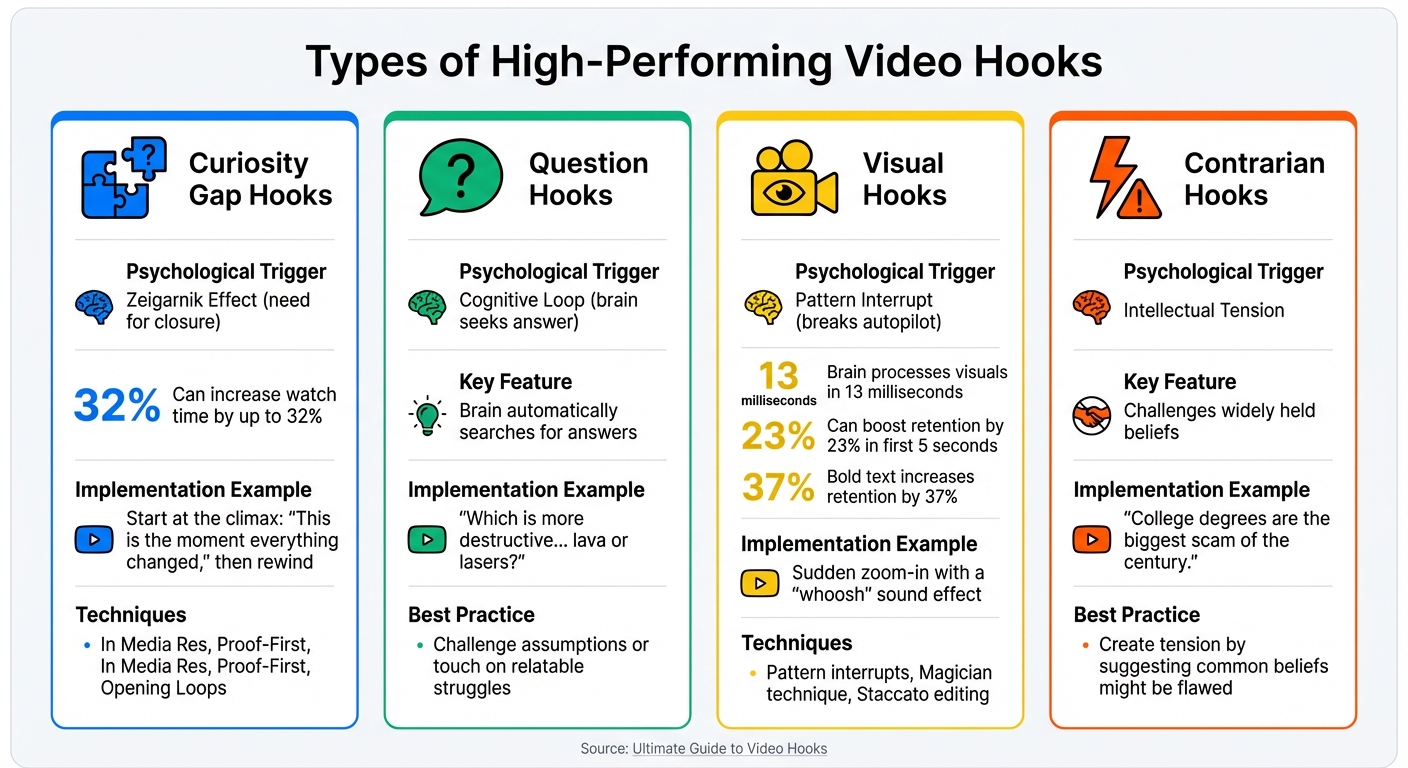
4 Types of High-Performing Video Hooks Comparison
Not every hook grabs attention in the same way. Different hooks trigger different psychological responses, and knowing how they work can help you craft content that truly connects. Three of the most effective types are curiosity gap hooks, question hooks, and visual hooks - each leveraging unique mental triggers to captivate viewers.
Curiosity Gap Hooks
Curiosity gap hooks work by teasing just enough information to spark intrigue while holding back the full story. This taps into the Zeigarnik Effect, which explains why people feel compelled to seek closure on incomplete ideas.
Techniques like the "In Media Res" approach drop viewers right into the most dramatic part of your story before rewinding to explain how it all unfolded. Similarly, the "Proof-First" tactic flashes the end result - like a completed project or a stunning transformation - right at the start to pique interest.
Another powerful strategy is opening loops. By hinting at a secret or insight that won’t be revealed until later, you can increase watch time by up to 32%. For example, instead of saying, "I'll show you how I grew my channel", you might say, "I posted one video every day for 30 days. Here’s what happened".
Question Hooks
Questions are a natural way to draw people in. When someone hears a question, their brain automatically starts searching for an answer, creating a mental loop that demands resolution. The trick is to ask questions that challenge assumptions or touch on relatable struggles.
"Which is more destructive... lava or lasers?"
Contrarian questions are particularly effective. For instance, asking, "What if everything you know about dieting is wrong?" creates tension by suggesting that widely held beliefs might be flawed.
Avoid generic questions that feel flat or uninspired. Instead, focus on crafting ones that hint at surprising, thought-provoking answers.
While questions engage the mind, visuals grab attention instantly.
Visual Hooks
Visual hooks are all about making an immediate impact. Since the brain processes visuals in just 13 milliseconds - much faster than text or speech - they’re perfect for stopping the scroll. One way to do this is through pattern interrupts, which are unexpected visual elements that catch viewers off guard. Videos that use these within the first 5 seconds often see retention rates increase by 23%.
Examples of pattern interrupts include sudden zoom-ins, whip pans, or props that seem out of place. The "Magician" technique uses rhythmic movements - like snapping fingers or stacking objects - to create a dynamic visual rhythm that keeps viewers engaged. Staccato editing, which involves quick jump cuts between short sentences, also helps maintain energy and focus.
For maximum impact, aim for what creator Omer Bernstein calls "max alignment" - when visuals, spoken words, on-screen text, and audio all work together to amplify the same message. Adding bold on-screen text (3–5 words) that reinforces your verbal hook can boost viewer retention by 37% within the first 5 seconds.
Hook Type
Psychological Trigger
Implementation Example
Curiosity Gap
Zeigarnik Effect (need for closure)
Start at the climax: "This is the moment everything changed", then rewind
Question
Cognitive Loop (brain seeks answer)
"Which is more destructive... lava or lasers?"
Visual
Pattern Interrupt (breaks autopilot)
Sudden zoom-in with a "whoosh" sound effect
Contrarian
Intellectual Tension
"College degrees are the biggest scam of the century."
How to Create Effective Hooks: Step-by-Step
Creating a strong hook involves a clear process: focus on clarity, tap into emotions, and refine your approach with data.
Step 1: Define Your Value Proposition
You have just 1.5 to 3 seconds to answer the question, "What's in it for me?" Viewers decide almost instantly whether to keep watching, so there’s no room for a slow start.
Begin by identifying the promise - the specific benefit your video delivers. For example, if your title is "How to Gain 1,000 Subscribers", dive right into that topic within the first few seconds. This immediate alignment between your title, thumbnail, and opening line helps establish trust and keeps viewers engaged.
The PVSS Formula can help structure your hook:
- Promise: What the viewer will gain.
- Validation: Why they should trust you.
- Structure: How the content flows.
- Stakes: What they’ll miss if they leave.
"If your title is 'how to turn on a lamp'... please do not open your video with 'Hi! My name is ______. Welcome back to my channel.' They know. That's why they clicked." - Tim Schmoyer, Video Creators
Show the end result first. For instance, in 2025, The Dermatology and Laser Group boosted viewer engagement by starting their videos with glowing skin transformations rather than clinic introductions. This "outcome-first" strategy encouraged viewers to stay and learn how to achieve the result themselves.
Once your promise is set, take your hook to the next level by adding emotional triggers.
Step 2: Use Emotional Triggers
Emotion is a powerful driver of action. The best hooks leverage curiosity, urgency, surprise, or relatability to connect with viewers instantly.
- Curiosity: Create a gap between what viewers know and what they want to learn. Techniques like "Open Loops" (leaving a story unfinished) can increase watch time by 32%. Starting "In Media Res" - right in the middle of a dramatic moment - can also grab attention.
- Urgency and Fear: Phrases like "Stop doing this if you want to..." or "You're losing money every day because..." create a sense of immediate action. When paired with a desired outcome, these hooks make the stakes impossible to ignore.
- Surprise: Break expectations with shocking stats, bold claims, or visuals that catch viewers off guard. A surprising hook can snap viewers out of their scrolling routine.
- Relatability: Speak directly to your audience’s struggles. Lines like "If you're a small business owner struggling with..." make your content feel personal and relevant.
After crafting an emotional and value-driven hook, it’s time to test its effectiveness.
Step 3: Test and Refine With Data
Start by tracking your baseline metrics - views, watch time, and engagement - over two weeks. Then, create 3–5 hook variations for each video. For example, try one descriptive hook, one designed to spark curiosity, and one with a contrarian angle. Test each version separately while keeping other factors constant to measure their impact.
Focus on the first 48 hours, as this is when short-form content typically gains the most traction. Use statistically significant data to identify the winning hook. Pay attention to patterns: Does your audience engage more with questions or bold statements? Are visual hooks more effective than verbal ones?
Tools like Outlier (https://outlier.so) can speed up this process. By analyzing competitor content and trends, Outlier provides data-driven video ideas, suggested titles, hooks, and confidence scores in just two minutes. This allows you to spot winning patterns before you even start recording.
Once you’ve identified a successful hook style, build a template library to replicate it across future videos. Dedicate time each month to review your top-performing hooks across different platforms and audience segments. By refining your hooks with performance data, you could see a 34% increase in average watch time within the first month.
sbb-itb-08cadfc
Common Mistakes When Creating Hooks
Crafting a strong hook can make or break your video. Yet, it’s easy to stumble into pitfalls that can sabotage your content’s potential. Let’s dive into three common mistakes that creators often make - and how to avoid them.
Mistake 1: Overloading the Hook
Giving away too much information upfront kills curiosity. If you explain the entire context, backstory, and setup right at the beginning, viewers won’t feel compelled to stick around. A hook should tease just enough to pique interest, not spill all the details.
You’ve got 3 to 5 seconds - maybe 10 if you’re lucky - to grab attention before viewers scroll away. Yet, many creators waste this crucial window with animated logos, generic intros like “Hey guys, welcome back,” or drawn-out explanations that confuse or bore the audience.
Mark Rober, a YouTube powerhouse, stresses that every second counts: “Cut anything that doesn’t actively engage your viewers”.
How to fix it: Script your opening lines carefully. Aim for 1–2 sentences that get straight to the point. Cut filler phrases and avoid unnecessary pleasantries. Start mid-action or with a bold statement that sparks curiosity. For example, instead of saying, “Today I’ll teach you how to edit videos faster,” try, “This one shortcut slashed my editing time in half.” It’s concise, intriguing, and leaves the viewer wanting more.
Mistake 2: Ignoring Visual Elements
If your hook relies only on spoken words, you’re missing a major opportunity. The human brain processes visuals in just 13 milliseconds, making them a powerful tool to grab attention. A static or bland opening risks losing viewers instantly.
"Nobody remembers safe openings. The scroll is full of them. But a video hook is different – it hits before anyone even blinks."
Sarah Mitchell, Broadcast2World
How to fix it: Pair your verbal hook with dynamic visuals. Incorporate quick camera movements, surprising angles, or dramatic sound effects in the first few seconds. Whenever possible, show the end result right away - it’s an instant attention-grabber. Every frame should work to keep viewers engaged.
Mistake 3: Not Testing Enough
Relying on a single hook without testing is like guessing in the dark. If you don’t experiment with different variations and analyze your retention data, you’ll likely repeat the same mistakes. This often results in the dreaded "Deep L" retention curve, where most viewers drop off within the first 20 seconds.
Platforms like YouTube and TikTok reward high retention rates. If your hook doesn’t work and viewers leave immediately, the algorithm will stop pushing your content.
"You have to make it clear why someone should keep watching - right away. If they don't see the value in the first few seconds, they're gone."
Marques Brownlee (MKBHD)
How to fix it: Use analytics to identify where viewers drop off. If there’s a steep decline in the first 15 seconds, it’s time to rethink your approach. Run A/B tests with different hooks - try comparing a bold statement with a question or a visual-heavy start with a verbal one. Over time, build a library of high-performing templates to streamline your process. Testing isn’t optional - it’s the only way to know what truly works.
Measuring and Improving Hook Performance
Crafting a strong hook is just the beginning. The real challenge lies in understanding whether it resonates with your audience - and figuring out how to refine it. Without tracking the right metrics, you’re essentially flying blind.
Key Metrics to Track
The first 30 seconds of audience retention is your most critical metric. It shows how many viewers stick around after the opening. If you notice a sharp drop-off during this time, it’s a clear sign that your hook needs work.
Your click-through rate (CTR) is another essential measure. It reflects how many people click on your video after seeing the thumbnail and title. For most YouTube videos, CTR ranges between 2% and 10%, with anything above 6% considered a solid result. Think of the CTR as your "external hook" - it draws people in - while the average view duration (AVD) acts as your "internal hook", showing whether your introduction successfully transitions viewers into the main content. YouTube’s algorithm prioritizes AVD because it demonstrates genuine viewer engagement.
"A view only says someone clicked play. Engagement shows whether they actually stayed."
Podcastle
You should also study your retention curve in YouTube Analytics. This tool highlights where viewers drop off or rewatch segments. Peaks and valleys in the curve can pinpoint exactly where your hook either grabs attention or loses it. Additionally, relative audience retention compares your video’s performance against others of similar length, helping you gauge whether your hook stands out.
These metrics form the foundation for refining your hook strategy.
A/B Testing Your Hooks
Once you’ve identified areas for improvement, it’s time to test and tweak. A/B testing is the most effective way to determine what works, but it’s crucial to change only one variable at a time. For example, if you adjust both the verbal hook and the visual opener simultaneously, you won’t know which change made the difference.
When testing thumbnails and titles, give your video about five days post-publication to stabilize subscriber views. After that, monitor analytics for 3 to 7 days to gather meaningful data.
Focus on the percentage of viewers still watching at the 30-second mark for each variation. Compare your results to the gray "typical retention" line in YouTube Analytics - if your updated hook outperforms this baseline, you’re on the right track.
By systematically testing and refining, you can develop hooks that consistently hold attention.
Using Outlier for Data-Driven Insights
Guesswork has no place in creating effective hooks. That’s where tools like Outlier come in. This platform analyzes competitor videos to uncover successful hook patterns within your niche. It identifies top-performing “outlier” videos and highlights what makes their hooks effective.
Outlier also provides personalized video ideas, complete with suggested titles, hooks, and confidence scores. You’ll gain access to view velocity data and proven strategies from successful creators, helping you understand why certain hooks work. The AI script analysis feature evaluates your hooks for pacing, curiosity, and overall impact before filming, saving you from costly trial and error.
"The script analysis feature is incredible. It showed me exactly why my hooks weren't working. Fixed it, and my numbers improved dramatically."
Swapnil, Content Creator
The platform’s gap analysis is another powerful tool. It helps you identify “winnable” topics by targeting high-demand, low-competition keywords. This ensures your hooks align with viewer interests, significantly boosting your chances of success. With free plans offering 10 personalized video ideas, Outlier makes it easier than ever to move from guesswork to a data-driven approach.
Conclusion
Your hook is the deciding factor in whether viewers stick around or scroll past. While a strong hook doesn't guarantee your content will go viral, a weak one almost guarantees it'll be ignored. On platforms like TikTok and Instagram Reels, the first 3–5 seconds are critical, while YouTube gives you slightly more time - about 5–20 seconds - to capture attention.
Cut the fluff, deliver value immediately, and make sure your visuals align with your message. As Mark Rober wisely says:
"Every second of my video is precious. If a quarter second is not doing something in my video, I will cut it out".
This level of precision separates creators who consistently hold attention from those whose retention rates drop off dramatically.
Experiment with different openings. Use viewer drop-off data to refine your approach. Techniques like pattern interrupts and open loops can make a noticeable difference in keeping viewers engaged. These small but impactful adjustments often define the line between success and failure.
Incorporating data-driven tools can make this process smoother. Tools like Outlier take the guesswork out of brainstorming by analyzing trends in your niche. In just two minutes, you can get personalized video ideas with recommended hooks, confidence scores, and insights drawn from top-performing creators. Even their free plan offers 10 video ideas, helping you shift from trial-and-error to a more strategic approach.
Write your opening lines with precision. Remove unnecessary words and test them against your current version. Let data guide you on what resonates and what falls flat.
FAQs
What’s the best way to test and improve my video hooks?
To fine-tune your video hooks and make them more effective, start by establishing a baseline metric. This could be your click-through rate (CTR) or how well your audience sticks around during the first 5–10 seconds of your video. Then, experiment with different hook variations - like opening with a surprising question, a striking visual, or a brief, compelling value statement - and track how each performs. Use analytics tools to monitor key metrics such as CTR, average watch time, and retention to pinpoint which hooks resonate most with your audience.
Once you've collected enough data, zero in on the elements that performed well. For instance, an eye-catching visual or a thought-provoking question in the first few seconds can significantly improve viewer retention. Refine your wording to make it sharper, cut out anything unnecessary, and run new tests. By continuously repeating this cycle of testing, analyzing, and tweaking, you’ll create hooks that consistently capture attention right from the start.
What are the most effective emotional triggers to keep viewers engaged?
The best ways to capture viewers' attention often tap into curiosity, fear or urgency, and surprise. Curiosity draws people in with thought-provoking questions or enticing teasers. Fear or urgency grabs attention by presenting startling facts or creating a sense of "you need to know this now." Meanwhile, surprise keeps things fresh by subverting expectations - whether through unexpected visuals or an unpredictable twist in the story.
Incorporating these emotional triggers smartly into your video hooks can keep your audience glued to the screen.
How can visual hooks boost viewer retention in videos?
Grabbing attention right from the start is crucial in video creation, and visual hooks like jump cuts, zoom-ins, and other eye-catching techniques can do just that. These tools can boost average viewer retention by approximately 23%, helping more people stick around beyond the initial moments.
By shaking things up and keeping visuals fresh and dynamic, these hooks ensure your video remains engaging, encouraging your audience to stay with you longer.


