

Upload Frequency vs. Consistency: What Matters More?
Both upload frequency and consistency are essential for YouTube growth, but they serve different purposes.
- Frequency: Posting often increases visibility, boosts discovery, and signals activity to YouTube's algorithm. However, too many uploads can lead to burnout, quality drops, and audience fatigue. The algorithm prioritizes quality over sheer volume, especially with its 2025 updates.
- Consistency: Sticking to a predictable schedule builds trust with your audience, improves retention, and strengthens engagement. Regular uploads help the algorithm identify your channel as reliable, which can push your content to more viewers.
Key takeaway: The best approach is finding a balance. Start with a sustainable schedule (e.g., one high-quality video per week) and adjust based on analytics like watch time and audience engagement. Test what works for your channel without sacrificing quality or exhausting yourself.
Do You HAVE to Be CONSISTENT to GROW ON YOUTUBE in 2021?
What is Upload Frequency?
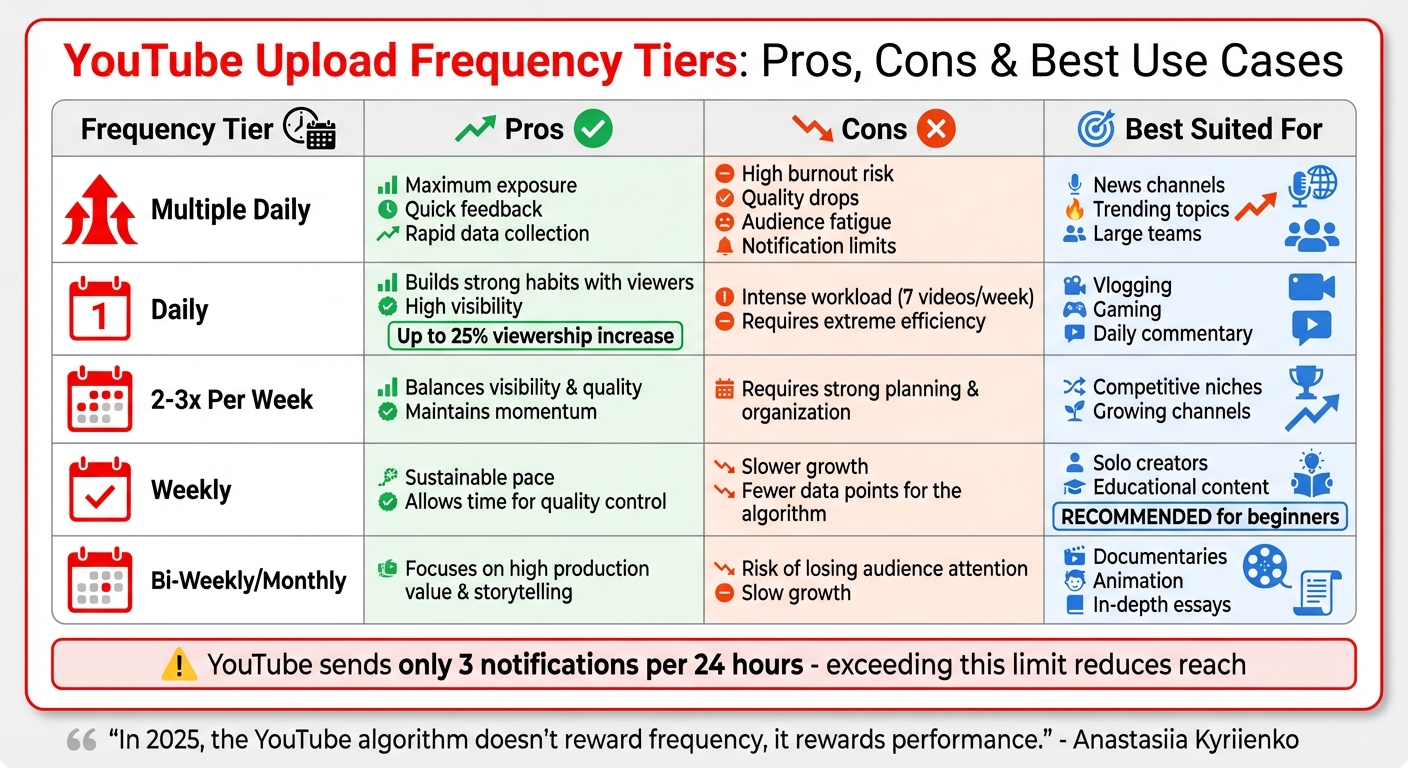
YouTube Upload Frequency Tiers: Pros, Cons, and Best Use Cases
Upload frequency refers to how often you publish videos within a set period, whether that's daily, weekly, or monthly. It's essentially the raw count of content you share. But there's more to it than just numbers - YouTube Analytics provides deeper insights by tracking metrics like Unique Viewers and Average Views per Viewer. These tools help you determine whether your upload schedule is striking the right chord with your audience.
Every new upload signals activity to YouTube, which can increase recommendations and create more opportunities for discovery. However, there’s a practical limit to keep in mind: YouTube only sends out three notifications per 24-hour period. If you exceed this, some videos might not reach your subscribers' notification feeds, potentially weakening their immediate impact.
Pros and Cons of Frequent Uploads
Uploading more often can help your channel grow faster, but it comes with its own set of challenges. Some creators report viewership increases of up to 25% when posting daily. However, this boost often comes at the expense of quality, energy, and long-term sustainability.
Frequency Tier
Pros
Cons
Best Suited For
Multiple Daily
Maximum exposure, quick feedback, rapid data collection
High burnout risk, quality drops, audience fatigue, notification limits
News channels, trending topics, large teams
Daily
Builds strong habits with viewers, high visibility
Intense workload (7 videos a week), requires extreme efficiency
Vlogging, gaming, daily commentary
2-3x Per Week
Balances visibility and quality, maintains momentum
Requires strong planning and organization
Competitive niches, growing channels
Weekly
Sustainable pace, allows time for quality control
Slower growth, fewer data points for the algorithm
Solo creators, educational content
Bi-Weekly/Monthly
Focuses on high production value and storytelling
Risk of losing audience attention, slow growth
Documentaries, animation, in-depth essays
While frequent uploads can boost visibility, they also bring risks. Rushing to meet a tight schedule often leads to cutting corners - whether that's in editing, content ideas, or storytelling. Weak video titles or poor execution can hurt your subscriber growth and overall channel performance. And with YouTube's 2025 algorithm, quality metrics like watch time and retention hold more weight than sheer upload volume.
"In 2025, the YouTube algorithm doesn't reward frequency, it rewards performance." – Anastasiia Kyriienko
There’s also the personal toll to consider. A daily upload schedule can overwhelm solo creators, leaving them burnt out, while also exhausting their audience. If viewers disengage, the algorithm may interpret this as a lack of interest in your content. Striking the right balance between frequency and quality is essential.
For many creators, starting with one high-quality video per week is a manageable and effective approach. Batch production - creating multiple videos in one go - can also help reduce stress and maintain consistency. The key is finding a schedule that works for you without sacrificing the quality your audience expects.
What is Consistency in Uploading?
While upload frequency focuses on how often you post, consistency is all about reliability - and that reliability plays a huge role in keeping your audience engaged over time.
Consistency means sticking to a dependable posting schedule. Think of it like your favorite TV show airing every Tuesday. That regularity builds trust and keeps viewers coming back. It’s not just about how many videos you post, but about sticking to a rhythm your audience can count on. Plus, a steady schedule helps YouTube’s algorithm recognize your channel as active and worth promoting.
"Consistency is about predictability and reliability over time... meeting the expectations you set for your audience." – Jess Prasida, Author and Creative Advisor
Pros and Cons of Consistency
The numbers don’t lie: a reliable posting schedule can seriously boost engagement. A Buffer study of over 100,000 users across 26 weeks found that channels posting consistently - at least once a week for 20 or more weeks - saw 5x more engagement (likes, comments, shares) per post compared to those posting sporadically. Even creators posting in just 5–19 of the 26 weeks enjoyed 340% more engagement per post.
"The most consistent posters received a whopping 5x more engagement - likes, comments, and shares - per post than users who posted inconsistently." – Julian Winterhiemer, Data Scientist at Buffer
Consistency doesn’t just help with engagement - it also boosts your chances of getting recommended by YouTube. Regular activity signals the platform that your channel is active, making it more likely to push your content to both subscribers and new viewers.
That said, there are downsides. Posting too infrequently - like once a month - can slow your channel’s growth. Fewer uploads mean fewer chances for discovery, and long gaps between videos can cause your audience to lose interest.
Consistency Level
Engagement Gain
Best Practice
Potential Risk
Highly Consistent (20+ weeks out of 26)
Up to 450% more engagement
Post weekly; batch content to stay ahead
Requires strong planning and discipline
Moderately Consistent (5–19 weeks out of 26)
340% more engagement per post
Stick to a manageable schedule, like bi-weekly
Growth may be slower than highly consistent posting
Inconsistent (4 weeks or fewer out of 26)
Baseline engagement (1x)
Use the Community Tab to update your audience during breaks
Risk of losing viewers and algorithmic visibility
Interestingly, Buffer’s data suggests that around 21 weeks of consistent posting is a sweet spot. Beyond that, engagement gains tend to level off. This shows that you don’t have to be perfect - just steady.
"Consistency trumps volume every time. When your audience knows when to expect new content, they're more likely to subscribe, return, and engage." – Tanmay Ratnaparkhe, Co-founder of Predis.ai
To make the most of YouTube’s algorithm, it’s crucial to balance consistency with your upload frequency strategy. A reliable schedule can help you build trust, grow your audience, and keep your channel thriving.
sbb-itb-08cadfc
How the YouTube Algorithm Responds to Frequency vs. Consistency
The YouTube algorithm has come a long way, and knowing how it handles frequency versus consistency can significantly impact your channel's growth. While both play a role, the algorithm now favors quality signals over sheer quantity.
Here's the key distinction: posting frequently provides the algorithm with more data to test your content, while consistent uploads help build viewer habits and retention - the metrics the algorithm values most. For instance, uploading daily can give you more chances to appear in recommendations. However, if those frequent uploads result in rushed, low-quality content with poor retention, the algorithm flags this as a negative.
"Consistency + strong AVD + a clear content system outperform raw upload frequency every time." – Iryna Avramenko, Author, AIR Media-Tech
The algorithm evaluates metrics differently depending on your strategy. Frequency affects discovery metrics like impressions, reach, and overall engagement volume. Consistency, however, impacts retention metrics such as Average View Duration (AVD), watch time, and Average Views per Viewer (APV). Posting regularly helps establish strong viewing habits, signaling to YouTube that your channel consistently delivers value. This boosts your visibility in "Browse" and "Suggested" feeds.
"The algorithm rewards long-term engagement patterns, not short-term posting frequency." – Iryna Avramenko, Author, AIR Media-Tech
Content type also influences how the algorithm responds. For YouTube Shorts, a higher posting frequency - around 2–3 times per week - can significantly increase your reach. On the other hand, long-form content benefits more from a focus on quality. Daily uploads of long-form videos might temporarily boost views, but they often lead to burnout and declining retention. Many successful creators have adopted a "weekly anchor" strategy, producing one high-quality video per week, which aligns better with the algorithm's preference for sustained viewer engagement.
Finding the Right Balance
There’s no universal upload schedule that works for everyone - it all comes down to your channel, resources, and audience. The trick is to find a rhythm that fits your capacity while keeping your viewers engaged. Start by evaluating how many videos you can produce weekly without sacrificing quality. For most solo creators, one well-crafted long-form video per week is a reliable starting point. YouTube Shorts, on the other hand, can be posted 2–3 times a week to help expand your reach.
Your niche heavily influences your schedule. For example, if your content focuses on time-sensitive topics like news or trends, daily uploads might be necessary. Meanwhile, educational or high-production videos often perform better with weekly or bi-weekly releases. Keep in mind, increasing your posting frequency might boost metrics but could also impact the depth of your research or the quality of your ideas.
Experimentation is key. Try adjusting your schedule by adding or reducing one video per week. Test this for 4–8 weeks to see how it impacts your performance. Pay close attention to your AVPV (Average View Percentage per Video). A ratio of 2 or higher signals strong engagement, while a ratio of 1 or lower suggests it’s time to focus more on quality.
"The sweet spot is different for each creator, and you'll only discover it by uploading more content and learning as much as you can about your audience." – Lydia Sweatt, Blog Manager, vidIQ
Leverage tools like YouTube Studio’s "When your viewers are on YouTube" chart to time your uploads just before peak activity. You can also use the Community tab to poll your audience about their preferred upload days and frequency. Remember, YouTube limits subscriber notifications to three per day, so posting more than three videos in 24 hours might actually work against you. Using this kind of data ensures you’re making informed decisions about your schedule.
Using Data to Inform Your Strategy
Data should guide your content strategy - not guesswork. A tool like Outlier can analyze 90 days of competitor data in just two minutes. It identifies trending topics, suggests video ideas with titles and hooks, and even provides confidence scores and view velocity data - all without needing a subscription or linking your YouTube account.
This data-driven approach helps you fine-tune your posting schedule. By understanding which topics are gaining momentum and how often your competitors are uploading, you can align your strategy with proven trends. With insights like these, you can focus on what works and leave the guesswork behind.
Conclusion
When it comes to balancing upload frequency and consistency, it’s not about picking one over the other - it’s about striking the right balance for your channel. Consistency helps build trust and predictability with your audience, while frequency keeps you relevant in a space where 3.7 million videos are uploaded every single day. But here’s the thing: the YouTube algorithm doesn’t just reward how many videos you upload. It’s all about performance metrics like watch time, click-through rate, and viewer retention.
The real key to success lies in creating a sustainable upload schedule. That might mean posting one high-quality long-form video each week or mixing it up with a combination of deep-dive content and 2–3 Shorts. The important part? Stick to a pace that works for you - one that doesn’t lead to burnout or compromise the quality of your content.
Let your decisions be guided by data, not generic advice. YouTube Analytics can show you when your audience is most active, how many videos they watch in one sitting, and whether increasing your upload frequency is actually growing your reach or just wearing out your existing viewers. Tools like Outlier can also give you a quick snapshot of what your competitors are doing, helping you refine your strategy.
Start with a schedule you know you can manage. Track your key metrics over time, and don’t be afraid to experiment with small changes. Give yourself 4–8 weeks to test adjustments, keeping an eye on unique viewers and retention rates. If something isn’t working, pivot based on what the data tells you. The path to sustainable YouTube growth lies in strategic, consistent posting - always guided by clear insights into your audience. Balance is everything.
FAQs
How do I figure out the right upload schedule for my YouTube channel?
To pinpoint the ideal upload schedule, start by diving into your YouTube Analytics. Pay attention to metrics like unique viewers, average watch time, and retention rates. If your audience tends to stick around for longer videos, they might be open to more frequent uploads. However, if engagement drops off quickly, a less aggressive schedule could work better. Experiment with different posting frequencies - try uploading twice a week for a month, then switch to once a week - and compare results like views, subscriber growth, and retention to see what resonates.
Your niche and resources also play a big role. For fast-moving topics like gaming or news, frequent uploads can keep your audience engaged. But if your content requires more time and effort, such as tutorials or highly polished productions, a weekly or bi-weekly schedule might be more effective. Whatever you decide, consistency is non-negotiable. YouTube’s algorithm favors creators who stick to a regular, predictable upload rhythm rather than sporadic posting.
To refine your strategy further, tools like Outlier can help you analyze competitor trends and identify upload patterns that drive success in your niche. By blending insights from your audience data, competitor research, and your own production capabilities, you can craft a schedule that supports both growth and viewer satisfaction.
How can I stay consistent with uploads without feeling overwhelmed?
Consistency is key to growing on YouTube, but it’s just as important to protect yourself from burnout. Start by setting up a content schedule that works for you. Be honest about how much you can handle - don’t commit to daily uploads if it’s not realistic. Plan your video topics ahead of time, but leave some flexibility for unexpected ideas or changes. A solid schedule keeps you on track and minimizes last-minute stress.
One of the best ways to save time is to batch-produce your videos. Record several videos in one session, edit them all together, and schedule uploads ahead of time. You can also use templates for thumbnails, intros, and descriptions to cut down on repetitive work. This frees up more energy for what really matters: creating high-quality, engaging content.
And don’t forget to pay attention to both your audience and yourself. Keep an eye on how different posting schedules affect your engagement, and adjust as needed. Equally important, take breaks when you need them, set boundaries for your work, and use tools like Outlier to generate fresh, data-driven video ideas. By balancing careful planning, efficient workflows, and self-care, you can stay consistent without running yourself ragged.
Does YouTube prioritize quality or frequency when recommending videos?
The YouTube algorithm values quality and engagement far more than the sheer number of uploads. Metrics like watch time, audience retention, click-through rates, likes, comments, and shares play a bigger role in determining your video's success. This means that well-crafted videos that captivate viewers are more likely to land in recommendations, search results, and the Home feed - even if you’re not uploading daily.
On the flip side, flooding your channel with low-performing videos can actually hurt its visibility. Poor engagement suggests to the algorithm that your content isn’t resonating with viewers. Instead of chasing quantity, focus on a consistent posting rhythm that meets your audience’s expectations while keeping your production quality high. Tools like Outlier can help refine your approach by offering data-backed suggestions for crafting better titles, hooks, and content strategies.
In the end, quality fuels growth, while consistency builds trust with your audience. Finding the right balance between the two is essential for long-term success.


